The essential questions for this unit of study are:
 How does reading help me become a better writer?
![clip_image001[1]](https://blogger.googleusercontent.com/img/b/R29vZ2xl/AVvXsEgDRX2_7zlEZLDCmWou5oHJr8RU-T8bEYtKRCErSDcEPWCJg0BxyTg3YkCMSmGw0B-nmV8P7utJCMTi9T3qHiOXoZzcaav1IbZf6Dl0uHVng4BtF6chhqTxLIM6P4Vwps4-KvVtuYHFJPdV//?imgmax=800 "clip_image001[1]") What can I learn from other authors and illustrators?
What can I learn from other authors and illustrators?
![clip_image001[2]](https://blogger.googleusercontent.com/img/b/R29vZ2xl/AVvXsEifGzrygOhvbzhCAIFsQELeTBiUiF7M1kjS9_QJbBUjeC6FHeKVPDtu2OOlBlntqKjuL4SQXAvX4ra-Af2aAXJxF2Er2pnq2lG_Y9Fpdadps2mWAMSGXa-f2RE9wRMZ7GzBLoacYRQ2vq4W//?imgmax=800 "clip_image001[2]") How can I make use of the craft of other authors and illustrators in my writing and drawing?
How can I make use of the craft of other authors and illustrators in my writing and drawing?
Cookie’s Week
by
Cindy Ward
Illustrations by Tomie dePaola

This week we studied the text, Cookie’s Week by Cindy Ward. This choice is for the following reasons:
· This is a text most students know and love (familiarity and prior knowledge)
· The structure is obvious (the listing of the days of the week)
· The illustrations are simple, large, and bright
· Text and pictures match (emphasizing picture-word match)
· There is vocabulary that extends the reader (toilet, upset, knocked, windowsill)
· The pattern within the structure is broken at the end (…”Cookie went everywhere!”)
· When our class rewrites the text, the format (structure) will be easy to replicate.
Monday-Teacher read the book and students listened.
Tuesday-Teacher and students read the book together. The students did a retell of the story. The teacher pointed out some punctuation: ellipses used throughout the story and exclamation marks which appear multiple times as well. The students practiced how to read using these marks and discussed how an author can change the flavor of the story by using them appropriately. We also looked at the spelling of the word knocked and discussed kn as a digraph. I had a student supply me with knife and know as other words beginning the same way.
Thursday-Students read the book chorally. I asked the following questions and got these responses:
· Why do you think Cindy Ward wrote this book? (purpose)
- “To help kids read”
- “To help kids learn the days of the week”
- “To teach kids not to do naughty things”
- “So kids will know how to read and write the days of the week”
- To show kids how pictures and words go together
· If Cindy Ward had a heart map, what would she have in it? (We use heart maps to list things and people that are near and dear to our hearts. The map is placed in our writing folder for future writing topics.)
· Who did Cindy Ward write this book for? (audience)
- “Her cat”
- “Children”
- Grown-ups
- “Babies
· Please rate this book for me. If you like this book, give it a thumb up. If you think this book is okay, give it a thumb sideways. If you don’t like this book, give it a thumb down.
- There were six thumbs up
- There were six thumbs sideways
- There were four thumbs down
It is important to note here that I added two questions this week. I continued to ask the students about purpose and audience and added the heart map question as well as asking students to give their opinion about the book. I want them to start connecting with books that speak to them and I want them to see that author’s can select their topics by familiarity.
Then I told my students:
We are going to make our own story like Cindy Ward’s, Cookie’s Week. You are going to help me write the text and then we will all illustrate different parts. We will put our story into a hard cover book and have our own story using the same structure Cindy Ward used but with different characters and different words.
Friday-The students read the text (chorally) as I pointed to the words. I wrote the word character on chart paper and asked,
· Who knows what a character is?
- A student replied, “A character is someone of something in a story or a movie.”
We further discussed that characters can be people, animals, or animated objects. I explained that we would have to pick a character for our book. I went on to tell them that our character could not be Cookie from the text because that character belongs to Cindy Ward. We took nominations from the floor for character names. We got plenty to choose from and voted. I am not sure that everyone understood why we should not use the name Cookie as the winning character’s name is…Garfield! I let this go… explaining why we should not use Garfield did not seem important at this time.
Once Garfield had been duly elected, I started to write on chart paper:
On Monday…Garfield
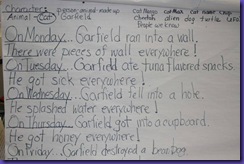
I told the students they would have to think up things for Garfield to do with consequences for his actions. This took a few tries for some students to catch on. About two thirds of them understood from the beginning what they were doing. Here is the text they came up with:
On Monday…
Garfield ran into a wall.
There were pieces of wall everywhere!
On Tuesday…
Garfield ate tuna flavored snacks.
He got sick everywhere!
On Wednesday…
Garfield fell into a hole.
He splashed water everywhere!
On Thursday…
Garfield got into a cupboard.
He got honey everywhere!
On Friday…
Garfield destroyed a bean bag chair.
There were beans everywhere!
On Saturday…
Garfield got chased by a dog.
Garfield went everywhere!
Tomorrow is Sunday…
Maybe Garfield will calm down! (We voted on the ending there were three suggestions)
I had some interesting observations during this drafting process.
· First, students of all abilities participated in this text creation.
· Second, there were about five students who remained silent throughout this process even though I stopped and encouraged them to contribute.
· Third, the student who contributed “tuna flavored snacks” could not understand the cause and effect part of this text. Another student supplied him with a reaction to the action and they collaborated beautifully in front of all of us. How lucky we were to get great vocabulary and maintain the structure of the text through collaboration. To me this solidified a group writing project as the rest of the class and I watched peer conferencing take place in front of us with no formal modeling yet. Both boys left that part of the text very happy with themselves and we had a very interesting albeit “gross” addition to our text!
· Fourth, a student supplied the idea of Garfield being chased and going everywhere for Friday. Another student immediately saw that the pattern was changing and offered that it should happen on Saturday (that is when Cindy Ward changed the pattern in her text). This really shows the detail that first graders are able to work with when using an author as a mentor.
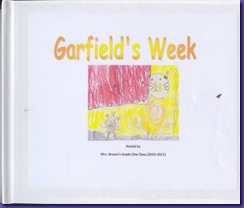
In the afternoon, the students and I did a cat drawing lesson. We worked on drawing a cat sitting and a cat moving. The lessons were simple step by step drawings. While I drew one part at a time, students had lap whiteboards and they drew along with me. We talked about making sure our character looks like a cat. Then we voted on the color of the cat as Garfield would have to be the same color throughout the text. Here is where I exercised my veto options. The class, by a twelve to four vote, wanted Garfield to be orange. I explained that the Garfield in the cartoons and funnies was orange and that Garfield belongs to another author/illustrator. We could color our Garfield yellowish-orange but not orange. They acquiesced.
The last step was to have students assigned to illustrate specific parts of the text. I read a line and asked for a volunteer. One by one the students offered to illustrate specific pages. I wrote their name next to the text on our chart paper. My student teacher wrote the text they were illustrating on a sticky note and stuck it onto their drawing rectangle. Then the child went off to illustrate. I left the drawings of the cats up so they could return to the rug to draw using models. There were more students than pages so two students drew end papers. There was a student absent. We will have him illustrate the title page. I am going to use one of the stronger illustration as the cover by color copying it.
During the illustration portion of this project, only one student was not engaged. He hung his head and pouted during the whole drawing process. I took him aside and asked if he would like me to draw with him as I had another student earlier. He agreed. Upon further investigation, he was feeling very vulnerable about his drawing. All it took was a bit of one on one time to bring a smile to his face and allow him to offer up his talent and his contribution to our book.


![clip_image001[1]](https://blogger.googleusercontent.com/img/b/R29vZ2xl/AVvXsEgAGxMs1z03ksTQbOuWRoZ0AZHU8efPQysM7idBd5H7Mq6y7Sq2dtyxlkzbA0zqOodJlgsTaMzigeqb5R1XXNgAeNOswFZ4VVJERkMQ5PbUpEaYnkmeiaLrx9nlWEopaVfeJ3pgihEHTkQv/s1600-h/clip_image001%5B1%5D%5B2%5D.gif "clip_image001[1]")
![clip_image001[2]](https://blogger.googleusercontent.com/img/b/R29vZ2xl/AVvXsEj-C4ncZDdwrQSpW5hBmsDtKIaf0EFox4g1EbRiftiqGcQgC2pw4E3-QE0NDA8n7q6wWRWt-LEWs2_LjIpi4_p_bTroXTSsx0OCl5pOcM3ExO9Njnn39sktQKavJ2QtCca800E6leC6jmyv/s1600-h/clip_image001%5B2%5D%5B2%5D.gif "clip_image001[2]")


![clip_image001[1]](https://blogger.googleusercontent.com/img/b/R29vZ2xl/AVvXsEiDZr_oT2i5gLNnuseJ3oHvBOKml0sb9pR1Wad3JUdSBn2YIu3KUnP7r3id3IBEcn7pctctWdN1ugnRY7WBdm4D9q6aeGiz6Ec-cN1NNDQRJ0lj3OaBTHFUpTRG5rSE5Y7vxaZzf5pO0vi0/s1600-h/clip_image001%5B1%5D%5B2%5D.gif "clip_image001[1]")
![clip_image001[2]](https://blogger.googleusercontent.com/img/b/R29vZ2xl/AVvXsEjoOIBUIoGcUp5LnGOz4mGmccxfp8uu4WUZIT2QD3AVozcgr_ssSyHVqNkEe4mZ8pONKNnlBpKrLWn_xlFylDjqKLzHtVOgTZenNJhH8-4xCWbEZAwPvCG8NrJ03q1XbJJTvElP76GDsKIg/s1600-h/clip_image001%5B2%5D%5B2%5D.gif "clip_image001[2]")


![clip_image001[1]](https://blogger.googleusercontent.com/img/b/R29vZ2xl/AVvXsEg_27tVaDhzJbjVgzgZil5AJiabbKTVRGtm38zLlPW_thGdCyYGqpC8jPidDwvLqSt-UPUuTZVaphTJCI_pM8-PiXgKIfFXDQcydTLomXlg-Spt01KAhVxziokrS9sKT7RPpdREEmvrYddm/s1600-h/clip_image001%5B1%5D%5B2%5D.gif "clip_image001[1]")
![clip_image001[2]](https://blogger.googleusercontent.com/img/b/R29vZ2xl/AVvXsEgJP7Ce-EDFxFMdbulGowaFfSmR_p9gb7rkUd0zqbAgi9_JxQ1zVMnifR_ANrJNloadyzpt2JTH6MJenOIoMkF70ZoL4YYc0QqJYbOn3BecY0fZdtrhKMtGy9KiD-Y6a9kusLOM5FmpG2fW/s1600-h/clip_image001%5B2%5D%5B2%5D.gif "clip_image001[2]")


![clip_image001[1]](https://blogger.googleusercontent.com/img/b/R29vZ2xl/AVvXsEi1CaTYZTSnvjsRTP2unzxEJq8hRqc8ZrhkwjsOwkh7enTPLhqBdDXVFBFLyR4P_G8AvhRiIrXuJBypmVqSNCLdnsXjNxzewSWKcVkhX5FeyytSqN6uGJM5CwA2TEU2JFNc9EUa5223th61/s1600-h/clip_image001%5B1%5D%5B2%5D.gif "clip_image001[1]")
![clip_image001[2]](https://blogger.googleusercontent.com/img/b/R29vZ2xl/AVvXsEhEG8cUBjxi-Pp-tn0y84m5kU2R5G55WbFConugG9q2iQfjVvc1nSpVww86KrlmPpcKi-V06NIuo_PolTYlH_WkzPG16TL2jJWZTFFq_62ZcOoljwg_qkEup44otgUHe0rb2crw4EwbqwD4/s1600-h/clip_image001%5B2%5D%5B2%5D.gif "clip_image001[2]")
![clip_image001[3]](https://blogger.googleusercontent.com/img/b/R29vZ2xl/AVvXsEidosvw2yqruZ_dpYha6fyRz0fp3WcJj_SxveZlGUeSWyF_KEZGYHmD8q0s7kiZkHWH4bo3udBRuuiE4UOaMcPwWE5IAL20FWpjMw-xXp2a9oaJ0nprJ-Ufdi2HU3cLj-H23HdUl8MSq5Yc/s1600-h/clip_image001%5B3%5D%5B2%5D.gif "clip_image001[3]")
![clip_image001[4]](https://blogger.googleusercontent.com/img/b/R29vZ2xl/AVvXsEhvSHn1Of6rJF_-c0tV0_xo181UjM7ojaU8AGxYeXwj7_ujneeHGgoSPfmf-UdwJLkdJpKiC4_HVVYVL6cxsmUE4Y08fHX0w4zU_N3Z0NA1v1CeKwQ7pC9t6SUsasEiswuK1t-mMXlHDPaO/s1600-h/clip_image001%5B4%5D%5B2%5D.gif "clip_image001[4]")
![clip_image001[5]](https://blogger.googleusercontent.com/img/b/R29vZ2xl/AVvXsEgtdkEuziKspy7PGEOkisrJ3BjPY-3KEiYBreBTlntnM8ZbC71OgjkPzQ8w4tkDZhTbRfw1C1ea4Cp1ASTmq4M0Pw1NsnmZWcpfldHyYvXjCh32FdtehriFYHMnwc0o_Y7dAbySWz1PaktS/s1600-h/clip_image001%5B5%5D%5B2%5D.gif "clip_image001[5]")
![clip_image001[6]](https://blogger.googleusercontent.com/img/b/R29vZ2xl/AVvXsEgpxQrXG-IWVopSQ6panvlRbYShyphenhyphenDlfmDpmLyDX2ygLspB4htZQahZQ57igphVxZvnLO5_yNpAT7rJ8H7ylhsG-RjDOIRcUYW96IGz2A8j_mkDMMgKc4BkaJdZr98Qc7T1yXRn5tJyepjLC/s1600-h/clip_image001%5B6%5D%5B2%5D.gif "clip_image001[6]")
![clip_image001[7]](https://blogger.googleusercontent.com/img/b/R29vZ2xl/AVvXsEidPpvnB2sCErbQsPkz045q9C6moiReeBHAUKgTk6KfTPaitVURclTwRWDw-QiVPj3UVx9arJbPAWe4QSW-1TkGxDnzceSCRmibhuuUttAftNP8-kNe7qda_hvj-K20XZ4MMIKOM5fz616x/s1600-h/clip_image001%5B7%5D%5B2%5D.gif "clip_image001[7]")
![clip_image001[8]](https://blogger.googleusercontent.com/img/b/R29vZ2xl/AVvXsEiwyvWNsS1mHTsWumo5Fr7DNITcmm7VP0ejamaQJ4OZpiKMeG6_dBsKMMsDoIJ7Tw2bHhyphenhyphenXk5P0kykEu9gayhCz_SNVTz00jPQbJZRUSCI_KrhUhHZLlsclC76ZMLvE8Yg7WEjjb5ubSsqP/s1600-h/clip_image001%5B8%5D%5B2%5D.gif "clip_image001[8]")
![clip_image001[9]](https://blogger.googleusercontent.com/img/b/R29vZ2xl/AVvXsEgIpox3T9b9N_eKa5u7ZLFoSW3CMFjx7LlBFnAsZPPkS840_wBMHv0KYZ28MhR4obdWVWoosXhzY36VPIQigUIm1Hhx06R7jwFTbpKsqrsLDjlUTekKeqKjgVgro4dD2bXJHNruW1BdN-Ib/s1600-h/clip_image001%5B9%5D%5B2%5D.gif "clip_image001[9]")
![clip_image001[10]](https://blogger.googleusercontent.com/img/b/R29vZ2xl/AVvXsEhDdd7pHAsPOLYq4F_93kzBPQI7c8hDBVbLqjJPp1EO-4TyC9vqkSYgfDYicWoFCq_jd6d7mN7edEgBxeuhPWV4H2GS5quk0xJU7qyGKdaLpojtf4S4sU0HNSTRReOdKz78NAvITnlWu-H0/s1600-h/clip_image001%5B10%5D%5B2%5D.gif "clip_image001[10]")
![clip_image001[11]](https://blogger.googleusercontent.com/img/b/R29vZ2xl/AVvXsEhWuIbaA6N3kbua1cT75rapBxuMz0SpEx3J1EuSZokIim4U_3BVxpq_c2oYZ2-xtcyizshKrWmPWrEgi8v-0QPOPwtOOz49x1yXcZ9T26qplT67cAFbKcrMwcAITnQPgUhhEM2uXY2kxfLm/s1600-h/clip_image001%5B11%5D%5B2%5D.gif "clip_image001[11]")
![clip_image001[12]](https://blogger.googleusercontent.com/img/b/R29vZ2xl/AVvXsEiYWEjR_FF7gtUbNIChhXmuaP1lx_BohindN0rs5Exvm65cULlBzafZChwKI81s2tK2rTcVXLfOBuaiXICkTYezGr7QNa-XIA36NSaN8i6-h7CnlnTZ8SCsPEfPUpIDcV1B0u3_fyCDVnmE/s1600-h/clip_image001%5B12%5D%5B2%5D.gif "clip_image001[12]")
![clip_image001[13]](https://blogger.googleusercontent.com/img/b/R29vZ2xl/AVvXsEiC8CPTcq-yqyYyKSbPN8gM9cbMJtWQgGGrSg1vqDoPnDNdsE6foSzeur1oQuPf0gJhyphenhyphenZrsrSnSQLWTb1VjBAvN5EusN95IiNRdT2IhLKbQ3Fnwdzd4rUdqYHWLVqfgGhocC872c97dg5Xi/s1600-h/clip_image001%5B13%5D%5B2%5D.gif "clip_image001[13]")

